What is skin biological age, and why does it matter?

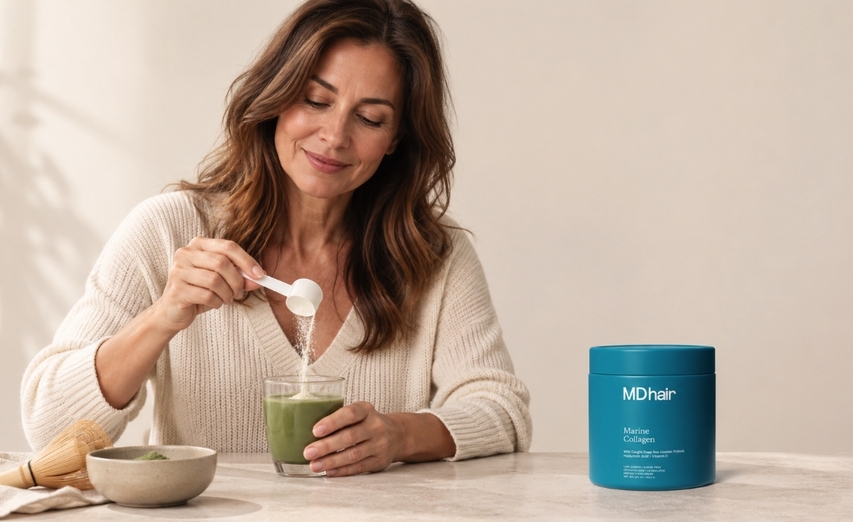
Quick answer: what should you look for in a collagen if you are shedding on a GLP-1?
- GLP-1 hair shedding is telogen effluvium — a temporary, diffuse shed triggered by rapid weight loss and a protein-and-energy shortfall, not by follicle damage. In a 2026 systematic review, GLP-1 users had an alopecia incidence of 6.0 per 1,000 patient-years versus 0.8 in placebo groups, with women at disproportionately higher risk [1].
- The right collagen for this situation is defined by three things: a verifiable amino acid profile, a low enough dose volume that you can actually swallow it on a suppressed appetite, and vitamin C in the same scoop.
- Glycine is the amino acid that matters most. Your body can make roughly 3 g/day while collagen synthesis alone needs about 10 g/day — a gap that widens sharply when you are eating less [3].
- Marine collagen has a measurable advantage for hair specifically. Fish collagen peptides increased dermal papilla cell proliferation, raised VEGF and IGF-1, lowered TGF-β1, and shifted follicles toward anagen in controlled studies [4,5].
Why does a GLP-1 cause hair shedding in the first place?
This section explains the mechanism, because the mechanism is what tells you which supplement is worth buying.
Semaglutide tirzepatide and the other GLP1's do not attack the hair follicle. What they do is produce fast, substantial weight loss while simultaneously suppressing appetite — and the follicle is caught in the middle.
Hair matrix keratinocytes are among the fastest-dividing cells in the human body. That makes them extraordinarily sensitive to any drop in available protein, energy, or micronutrients. When your body detects a sustained deficit, it triages: it protects the heart, brain, liver, and immune system, and it shuts down what is metabolically expensive and biologically optional. Hair is at the top of that optional list.
The follicle responds by pushing large numbers of hairs out of anagen (the growth phase) and into telogen (the resting phase) all at once. Two to four months later, those hairs release together. That delay is why so many people on a GLP-1 feel blindsided — the shedding starts long after the dose change that caused it.
The 2026 systematic review by Gupta and colleagues put numbers to this. High-dose semaglutide was associated with 7% alopecia incidence versus 3% in controls, and tirzepatide with 5.4% versus 0.9% with placebo [1]. A separate TriNetX cohort study found tirzepatide carried a higher telogen effluvium risk than other weight-loss medications [2]. The review authors were explicit that GLP-1 use is associated with insufficient dietary protein alongside iron, vitamin D, and B12 deficiencies — and that prevention centers on avoiding severe caloric restriction and ensuring adequate protein intake [1].
The encouraging part: there is no strong evidence of permanent follicular damage with GLP-1 use, and improvement typically follows within 3–6 months of weight stabilization [1].
Why does appetite suppression make the protein problem worse?
Because of what gets crowded out, not just how much. GLP-1 medications delay gastric emptying and blunt appetite, and the foods that become most aversive are frequently the dense protein foods — meat above all. Many people on these medications land at 40–60 g of protein per day when their requirement is meaningfully higher.
The practical consequence is a volume problem. A standard 25–30 g whey shake is 250–300 ml of liquid that a person with early satiety and low-grade nausea often simply cannot finish. Any supplement strategy that ignores volume tolerance will fail in the real world, regardless of how good the science behind it is.
What actually makes one collagen better than another for hair?
Most collagen marketing competes on source and story. The things that matter are measurable.
1. A published amino acid profile you can verify
Hydrolyzed collagen has an unmistakable chemical signature: glycine, proline, and hydroxyproline together should make up roughly 35–40% of total amino acids. Hydroxyproline in particular is the giveaway, because it is almost exclusive to collagen — it barely appears in other dietary proteins.
If a product does not publish a full amino acid table, you cannot confirm you are buying collagen rather than a cheaper protein blend. This is the single most useful filter available to a consumer, and it eliminates a surprising share of the category.
2. Genuinely hydrolyzed, low molecular weight peptides
Intact collagen is a large, poorly absorbed molecule. Enzymatic hydrolysis breaks it into short peptides that survive digestion and enter circulation as Pro-Hyp and Gly-Pro-Hyp — dipeptides and tripeptides measurable in blood and skin after oral ingestion [8].
This matters because these fragments are not just building blocks. Pro-Hyp stimulates fibroblast proliferation and hyaluronic acid synthesis in human dermal fibroblasts [6]. They act as signals, and the tissue they signal to includes the dermis surrounding and supporting each follicle.
3. Marine rather than bovine, if hair is the goal
Marine collagen is predominantly Type I, has a smaller particle size than bovine collagen, and dissolves in cold liquid. More importantly, the direct hair research has been done on fish collagen.
In human dermal papilla cells and C57BL/6 mice, fish collagen peptide increased cell proliferation, upregulated Wnt/β-catenin signaling, downregulated BMP signaling, raised VEGF (1.3× higher than positive control), IGF-1, and Ki67, and lowered the growth-inhibitory factor TGF-β1 [4]. Treated animals showed elevated anagen-to-telogen ratios with larger, deeper follicles. A follow-up study using tilapia scale collagen hydrolysate found it restored catalase activity in dermal papilla cells under oxidative stress, decreased TNF-α and IL-1β, and upregulated IGF-1, VEGF, elastin, and HAS2 [5].
Wnt/β-catenin activation and BMP suppression are the core molecular switches for anagen induction. That is a mechanistically coherent story for a shed driven by premature anagen exit.
Human data on marine collagen specifically is still limited, but it exists: a prospective, randomized, 3-month, controlled, assessor-blinded study evaluated an oral supplement containing amino acids, iron, selenium, and marine hydrolyzed collagen in subjects with androgenetic alopecia, female-pattern hair loss, or telogen effluvium [7]. Because that formula combined several actives, it cannot isolate the collagen's contribution — a limitation worth naming rather than glossing over.
4. Vitamin C in the same scoop — not optional
This is the detail most people miss. Prolyl hydroxylase and lysyl hydroxylase, the enzymes that build stable collagen, are absolutely vitamin C–dependent [9]. Without adequate ascorbate, the proline you supply never becomes hydroxyproline and the triple helix never stabilizes properly.
Vitamin C also increases non-heme iron absorption substantially [10] — which matters more than it sounds, because iron deficiency is one of the most common co-drivers of telogen effluvium in women [11,12], and women are the group at highest risk for GLP-1 shedding [1].
5. A dose you can actually take every day
A supplement taken 40% of the time does not work. On a GLP-1, the winning format is small volume, no fat, no dairy, mixes clear into whatever you are already drinking.
| Amino acid | g per serving | % of total |
|---|---|---|
| Glycine | 1.09 | 21.5% |
| Arginine | 0.54 | 10.7% |
| Proline | 0.53 | 10.5% |
| Glutamic acid | 0.49 | 9.7% |
| Alanine | 0.43 | 8.5% |
| Hydroxyproline | 0.34 | 6.7% |
| Serine | 0.30 | 5.9% |
| Aspartic acid | 0.24 | 4.7% |
| Lysine | 0.23 | 4.5% |
| Threonine | 0.19 | 3.8% |
| Hydroxylysine | 0.07 | 1.4% |
What does MDhair Marine Collagen's amino acid profile actually show?
Each 5.44 g scoop delivers hydrolyzed marine collagen, 90 mg vitamin C as calcium ascorbate, and 60 mg hyaluronic acid as sodium hyaluronate. The 20 listed amino acids total 5.06 g — which is 96% of the collagen mass in the scoop. There are no fillers, no bulking agents, and no added sugar.
Glycine + proline + hydroxyproline = 1.96 g, or 38.7% of total amino acids. That sits squarely in the authentic-collagen range. The presence of 0.34 g hydroxyproline and 0.07 g hydroxylysine confirms properly hydroxylated collagen rather than degraded or adulterated material.
Why is glycine at 21.5% the most important number on this label?
Glycine is classified as conditionally essential, which understates the problem. Meléndez-Hevia and colleagues calculated that human metabolism synthesizes about 3 g of glycine per day from serine, with diet contributing another 1.5–3.0 g — while collagen synthesis alone requires roughly 10 g daily for a 70 kg adult. Their conclusion was that most people run a glycine shortfall of around 10 g per day even under normal conditions [3].
Now apply a GLP-1. Intake falls, endogenous synthesis has no spare capacity, and the deficit widens.
Glycine is not a minor player. It occupies every third position in every collagen triple helix — including the collagen of the dermal sheath and the perifollicular connective tissue that anchors and supports each hair. It is also the rate-limiting substrate for glutathione, the follicle's primary antioxidant defense, which matters during the oxidative and metabolic stress of rapid weight loss. One scoop delivers 1.09 g, or roughly 33 g over a month.
What do the proline and hydroxyproline do?
Together they total 0.87 g per serving, with a hydroxyproline-to-proline ratio of 0.64. This is the fraction that becomes the circulating Pro-Hyp and Gly-Pro-Hyp peptides described above — the signaling fragments that reach dermal fibroblasts and upregulate proliferation, hyaluronic acid, and matrix synthesis [6,8]. The target tissue is precisely the perifollicular dermis that thins during rapid weight loss.
Why is the arginine content notable?
At 0.54 g, or 10.7%, arginine is unusually enriched in collagen compared with most dietary proteins. Arginine is the substrate for nitric oxide synthesis, which governs microvascular tone. Follicular blood supply determines how much of any nutrient actually reaches the dermal papilla — and delivery becomes the limiting step precisely when the body is in a catabolic state.
And the lysine?
0.23 g per serving. Lysine is an essential amino acid with a specific, long-standing connection to telogen effluvium in women — Rushton's work on nutritional factors in hair loss identified L-lysine alongside iron as relevant to chronic shedding [11]. Lysine also drives the enzymatic cross-linking that gives collagen its tensile strength, and it participates in iron handling.
Why calcium ascorbate rather than ascorbic acid?
Two reasons. It is the obligate cofactor for the hydroxylase enzymes, as described above [9]. And being buffered rather than free acid, it is materially gentler on a stomach already managing delayed gastric emptying and low-grade nausea. On a GLP-1, tolerability is not a nice-to-have — it is the difference between a product that gets used and one that sits in a cupboard.
The 60 mg of hyaluronic acid rounds this out by supporting the hydration of the same perifollicular extracellular matrix that the collagen peptides are signaling to.
How should you actually use collagen while on a GLP-1?
-
Get your total protein up first . People on a GLP-1 need roughly 1.2–1.6 g per kg of body weight — about 90–120 g for a 75 kg adult. The collegn should be layerd on top of about 90–120 g for a 75 kg adult. Anchor protein to your first meal, when appetite suppression is usually weakest. What you do not eat in the morning is rarely recovered later in the day.
Best Options:
- Lean chicken breast or turkey — roughly 30 g of protein per 100 g cooked, and the most protein you will get for the least stomach volume.
- White fish, eggs, or Greek yogurt — easier than red meat when nausea or meat aversion sets in, which is extremely common in the first months.
- A high-protein supplement powder — whey isolate or a complete plant blend, 20–25 g per scoop. Start with half a scoop in a smaller volume of liquid if a full shake is too much, and split it across the day rather than forcing it down at once. -
Get bloodwork before you guess. Ferritin, CBC, TSH, and vitamin D, as the systematic review recommends [1]. Iron deficiency is the most commonly missed and most correctable driver of shedding in women.
-
Add collagen daily and be consistent. Mix one scoop into coffee, tea, or water. The volume is small enough to take on the worst nausea days, which is the entire point.
-
Pair it with a cysteine source. Because collagen supplies none, combine it with eggs, whey, or a dedicated cysteine or NAC supplement so keratin synthesis has its sulfur amino acids.
-
Give it three months. Telogen effluvium recovery follows the hair cycle, not the calendar you would prefer. Visible density change generally requires 3–6 months after the underlying deficit is corrected [1].
-
Take monthly photos in the same light. Shedding is frightening in a way that makes self-assessment unreliable. Photographs are the only honest measure of whether you are improving.
Key takeaways
- GLP-1 hair shedding is a nutritional and metabolic problem, not follicle destruction, and it is reversible once the underlying deficit is corrected.
- Judge a collagen by its published amino acid table. Glycine, proline, and hydroxyproline should total 35–40%; if the table is missing, so is your ability to verify what you bought.
- MDhair Marine Collagen delivers 38.7% Gly-Pro-Hyp, 1.09 g of glycine, and 96% amino acid content by collagen mass — with vitamin C and hyaluronic acid in the same 5.44 g scoop.
- Marine collagen has the directly relevant hair research, with fish collagen peptides shifting dermal papilla signaling toward anagen via Wnt/β-catenin and away from BMP [4,5].
- Collagen contains no cystine or tryptophan. Pair it with a complete protein source rather than substituting it for one.
- Protein first, labs second, collagen third, patience throughout.
Frequently asked questions
Is collagen or biotin better for GLP-1 hair loss?
Neither is a cure, but collagen addresses a more plausible mechanism. Biotin deficiency is genuinely rare, and supplementing it when you are not deficient has little evidence behind it [12] — while also interfering with thyroid and troponin lab assays. GLP-1 shedding is driven by protein and energy shortfall, which is the gap collagen is positioned to help fill.
How much collagen should I take daily for hair?
Most clinical research on collagen peptides uses 2.5–10 g per day. MDhair Marine Collagen provides roughly 5.3 g of collagen per scoop, which sits in the studied range while staying small enough in volume to tolerate on a suppressed appetite.
How long until I see results?
Skin hydration and nail changes often appear first, around 4–6 weeks. Hair changes follow the hair cycle and generally become visible around month 3, with continued improvement through months 4–6 [1]. Anyone promising faster hair results is not describing hair biology.
Will collagen interfere with my GLP-1 medication?
There is no known interaction between hydrolyzed collagen and GLP-1 receptor agonists. Because the serving volume is small and fat-free, it is usually well tolerated even alongside delayed gastric emptying. As with any supplement, confirm with your prescribing physician.
Is marine collagen safe if I have a fish allergy?
No. MDhair Marine Collagen is derived from fish and is not appropriate if you have a fish allergy. It is also manufactured in a facility that processes milk, fish, tree nuts, wheatgrass, and peanuts.
Can collagen reverse GLP-1 hair loss on its own?
No, and we would be misleading you to suggest otherwise. Collagen supports the follicle's connective tissue environment and helps close a glycine gap. Recovery also depends on total protein intake, correcting iron and vitamin D deficiencies, and weight stabilization. Collagen is one component of that plan.
Should I take collagen before or after starting a GLP-1?
Ideally before, or at the same time. Because telogen effluvium shows up 2–4 months after the trigger, starting nutritional support at the beginning of treatment means the follicle is better supplied during the window when the shedding is being set in motion.
Does marine collagen smell or taste like fish?
Properly processed hydrolyzed marine collagen is deodorized and effectively flavorless. It dissolves in both cold and warm liquid, which is why it works in coffee or water rather than requiring a dedicated shake.
Is collagen enough protein while on a GLP-1?
No. Collagen lacks tryptophan and is very low in leucine, so it cannot serve as your primary protein source or preserve lean mass. Treat it as a targeted addition on top of adequate complete protein.
Shop now: MDhair GLP-1 Hair Support Kit (Amazon)
References
- Gupta AK, Teasell EM, Economopoulos V, Mirmirani P. GLP-1 therapies and hair loss: A systematic review of current evidence and implications for counseling. Science Progress. 2026;109(2). doi:10.1177/00368504261444578
- Neubauer Z, Ong MM, Singal A, Lipner SR. Increased risk of telogen effluvium with tirzepatide compared to other weight loss medications: A retrospective cohort TriNetX database study. Journal of the American Academy of Dermatology. 2025;93(6):1612–1614. doi:10.1016/j.jaad.2025.08.033
- Meléndez-Hevia E, de Paz-Lugo P, Cornish-Bowden A, Cárdenas ML. A weak link in metabolism: the metabolic capacity for glycine biosynthesis does not satisfy the need for collagen synthesis. Journal of Biosciences. 2009;34(6):853–872. doi:10.1007/s12038-009-0100-9
- Hwang SB, Park HJ, Lee BH. Hair-growth-promoting effects of the fish collagen peptide in human dermal papilla cells and C57BL/6 mice modulating Wnt/β-catenin and BMP signaling pathways. International Journal of Molecular Sciences. 2022;23(19):11904. doi:10.3390/ijms231911904
- Hwang SB, Park HJ, Lee BH. Collagen hydrolysate from the scales of Mozambique tilapia (Oreochromis mossambicus) improve hair and skin health by alleviating oxidative stress and inflammation and promoting hair growth and extracellular matrix factors. Marine Drugs. 2023;21(9):475. doi:10.3390/md21090475
- Ohara H, Ichikawa S, Matsumoto H, et al. Collagen-derived dipeptide, proline-hydroxyproline, stimulates cell proliferation and hyaluronic acid synthesis in cultured human dermal fibroblasts. The Journal of Dermatology. 2010;37(4):330–338. doi:10.1111/j.1346-8138.2010.00827.x
- Milani M, et al. Efficacy and tolerability of an oral supplement containing amino acids, iron, selenium, and marine hydrolyzed collagen in subjects with hair loss (androgenetic alopecia, AGA or FAGA or telogen effluvium). A prospective, randomized, 3-month, controlled, assessor-blinded study. Skin Research and Technology. 2023;29(7):e13381. doi:10.1111/srt.13381
- Shigemura Y, Kubomura D, Sato Y, Sato K. Oral ingestion of collagen hydrolysate leads to the transportation of highly concentrated Gly-Pro-Hyp and its hydrolyzed form of Pro-Hyp into the bloodstream and skin. Journal of Agricultural and Food Chemistry. 2017;65(11):2315–2322. doi:10.1021/acs.jafc.6b05679
- Peterkofsky B. Ascorbate requirement for hydroxylation and secretion of procollagen: relationship to inhibition of collagen synthesis in scurvy. The American Journal of Clinical Nutrition. 1991;54(6 Suppl):1135S–1140S. doi:10.1093/ajcn/54.6.1135s
- Hallberg L, Brune M, Rossander L. The role of vitamin C in iron absorption. International Journal for Vitamin and Nutrition Research. Supplement. 1989;30:103–108.
- Rushton DH. Nutritional factors and hair loss. Clinical and Experimental Dermatology. 2002;27(5):396–404. doi:10.1046/j.1365-2230.2002.01076.x
- Guo EL, Katta R. Diet and hair loss: effects of nutrient deficiency and supplement use. Dermatology Practical & Conceptual. 2017;7(1):1–10. doi:10.5826/dpc.0701a01
Related search terms
best collagen for GLP-1 hair loss, Ozempic hair loss collagen, semaglutide hair shedding supplement, tirzepatide telogen effluvium treatment, marine collagen for hair growth, collagen amino acid profile hair, glycine hair loss weight loss, hydrolyzed marine collagen benefits hair, does collagen help hair grow back after weight loss, Mounjaro hair thinning supplement, collagen vs protein powder GLP-1, hair loss rapid weight loss protein deficiency, Wegovy hair shedding how to stop, collagen vitamin C hair growth, best supplement for hair loss on weight loss injections
Find the hair treatment that fits your specific type of hair loss by taking the free MDhair assessment.
Recommended read
- Starting a GLP-1? Protect your hair before the shedding starts
- GLP-1 hair loss: how long until it grows back?
- Bovine or marine collagen — which is better?
- Collagen & vitamin C for hair growth: new clinical results
Find the most effective hair growth products for you by taking the free hair assessment.
Enjoyed this article? Add MDhair as a preferred source on Google.