Red Light Therapy Cap vs. Helmet for Hair Regrowth

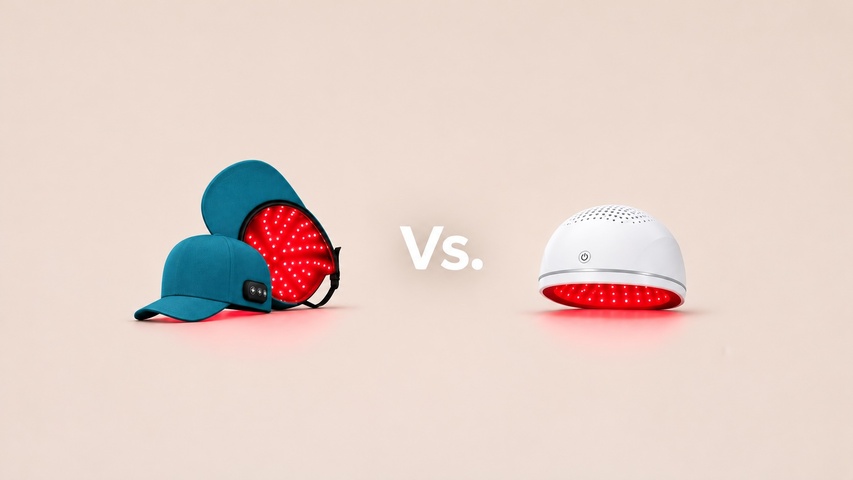
Red light therapy has become one of the most exciting at-home tools for thinning hair. It's drug-free, painless, and backed by more than a decade of clinical research. But if you've started shopping for a device, you've probably noticed two very different designs: bulky helmets and lightweight caps.
Both deliver therapeutic red light to the scalp. The real difference is how easily that light fits into your life, and that turns out to be the factor that matters most for results.
Quick Answer
Wireless red light caps deliver the same type of FDA-cleared light therapy as helmets, in a device that weighs about half as much, has no cord, and can be worn while you go about your day. A large meta-analysis found that the style of a red light device (cap, helmet or comb) did not make a meaningful difference to results. That makes comfort and ease of use the deciding factors, and that's where caps shine.
How Red Light Therapy Helps Hair Grow
Red light therapy, also called low-level light therapy (LLLT) or photobiomodulation, uses specific wavelengths of red light (typically 630–680 nm) to energize the cells of the hair follicle. Research shows it can:
- Boost cellular energy (ATP) production in follicle cells
- Improve blood flow to the scalp
- Help push resting follicles back into the active growth (anagen) phase
- Increase hair count, hair density and hair thickness over time
In 2025, a panel of 21 international experts published an evidence-based consensus in the Journal of the American Academy of Dermatology confirming that photobiomodulation is a safe and effective treatment option for androgenetic alopecia (pattern hair loss) and that red light does not cause DNA damage.
The Evolution of Red Light Hair Devices
The first generation of at-home red light devices for hair were hard-shell helmets. They worked, but they came with trade-offs: they were heavy, they were tethered to a power cord or an external battery pack, and they required you to sit still for 20–30 minutes at a time.
Today's newest devices take a different approach. Advances in compact medical-grade LEDs and high-capacity rechargeable batteries have made it possible to fit a full array of therapeutic lights inside a soft, lightweight cap that looks just like a regular baseball cap. Wireless, wearable caps are now the preferred technology for people who want consistent results without rearranging their day.
Cap vs. Helmet: Side-by-Side Comparison
| Feature | Wireless Red Light Cap | Traditional Helmet |
|---|---|---|
| Weight | About 250–285 g (around half a pound) | About 470–570 g (1–1.25 lb), plus the battery pack or cord |
| Power | Built-in rechargeable battery, no cord | Usually plugged in or tethered to an external battery pack |
| Freedom of movement | Walk, cook, work or read during treatment | Typically used sitting still near an outlet |
| Indoors and outdoors | Use at home, on a walk, in the car (as a passenger) or while traveling | Mainly an at-home, indoor device |
| Discretion | Looks like an ordinary baseball cap | Clearly a medical device |
| Comfort | Soft fabric shell and flexible inner liner that follows the shape of the head | Rigid shell; fit varies by head size and shape |
| Travel | Light and packable | Bulky to pack |
| Hands-free | Yes | Yes |
| Clinical evidence | FDA-cleared LED caps shown to increase hair density in a randomized, double-blind trial | FDA-cleared helmets shown to increase hair counts in randomized, double-blind trials |
The Benefits of Wireless Red Light Caps
1. Half the weight
A modern red light cap weighs roughly 250 grams, about the same as a smartphone and a wallet together. Traditional helmets typically weigh twice as much. That difference is easy to feel after a few minutes, and it's what makes a cap comfortable enough to wear while you move around.
2. Truly wireless
With a built-in rechargeable battery, there's no cord to trip over and no battery pack to clip to your belt. Charge it, put it on, and go.
3. Use it at home or on the go
Because a cap is light, wireless and discreet, you can use it during a morning walk, while working at your desk, while making breakfast, or while traveling. Treatment fits into your routine instead of interrupting it.
4. Consistency is what drives results
Red light therapy works through repeated sessions over months, typically showing visible improvement after 16–26 weeks. The best device is the one you'll actually use, consistently. A meta-analysis of 15 studies found that the device style (comb versus hat or helmet) did not significantly change outcomes. A device that's easy to wear every day gives you the best chance of sticking with it.
5. Comfortable and discreet
Soft fabric and flexible liners adapt to different head shapes, and the classic cap design means nobody needs to know you're doing a treatment.
What the Research Shows
Red light therapy for hair loss is supported by randomized controlled trials and multiple meta-analyses:
| Study | Design | Key Finding |
|---|---|---|
| Thomas et al., Dermatologic Surgery, 2025 | Multicenter, double-blind RCT of an FDA-cleared LED cap; 160 adults; 10-minute daily sessions | Cap users gained 28.5 more hairs per cm² than the sham group |
| Lanzafame et al., Lasers in Surgery and Medicine, 2013 | Double-blind RCT; 44 men; 655 nm red light, every other day for 16 weeks | 35–39% increase in hair growth versus placebo |
| Lanzafame et al., Lasers in Surgery and Medicine, 2014 | Double-blind RCT; 47 women; 655 nm red light, every other day for 16 weeks | 37% increase in hair growth versus placebo; no side effects reported |
| Suchonwanit et al., Lasers in Medical Science, 2019 | 24-week double-blind, sham-controlled RCT; 40 men and women | Significant increases in both hair density and hair thickness versus sham |
| Gupta & Carviel, Journal of Dermatological Treatment, 2021 | Meta-analysis of 15 studies (795 participants) | Red light therapy significantly increased hair density; device style (cap, helmet or comb) made no significant difference |
| Perez et al., Dermatologic Surgery, 2025 | Systematic review and meta-analysis; 38 studies, 3,098 patients | Hair density increased significantly versus placebo, with larger gains after 20+ weeks of use |
| Adil & Godwin, Journal of the American Academy of Dermatology, 2017 | Systematic review and meta-analysis of RCTs | Low-level light therapy was superior to placebo for hair growth in men |
| Maghfour et al., Journal of the American Academy of Dermatology, 2025 | International expert consensus (21 experts, Delphi process) | Photobiomodulation is a safe and effective treatment option for androgenetic alopecia |
How to Get the Best Results From a Red Light Cap
- Choose an FDA-cleared device with red wavelengths in the 630–680 nm range.
- Follow the recommended schedule, usually daily or every other day for the time set by the device.
- Wear it on a clean, dry scalp so the light reaches the skin.
- Be patient: most studies show measurable results at 16 weeks, with continued improvement through 6 months and beyond.
- Take monthly photos in the same lighting to track your progress.
- Combine it with a complete routine. Red light works well alongside topical regrowth serums, targeted nutrition and gentle scalp care.
The Bottom Line
Red light therapy is one of the best-studied at-home options for thinning hair. Helmets helped prove the technology works. Wireless caps make it easy to live with. At about half the weight, with no cords and the freedom to use it anywhere, a modern red light cap gives you the same proven light therapy in a form you'll actually want to wear every day.
References
- Thomas M, Stockslager M, Oakley J, Womble TM, Sinclair R. Clinical Safety and Efficacy of Dual Wavelength Low-Level Light Therapy in Androgenetic Alopecia: A Double-Blind Randomized Controlled Study. Dermatol Surg. 2025;51(4):416-421. doi:10.1097/DSS.0000000000004509
- Lanzafame RJ, Blanche RR, Bodian AB, et al. The growth of human scalp hair mediated by visible red light laser and LED sources in males. Lasers Surg Med. 2013;45(8):487-495. doi:10.1002/lsm.22173
- Lanzafame RJ, Blanche RR, Chiacchierini RP, Kazmirek ER, Sklar JA. The growth of human scalp hair in females using visible red light laser and LED sources. Lasers Surg Med. 2014;46(8):601-607. doi:10.1002/lsm.22277
- Suchonwanit P, Chalermroj N, Khunkhet S. Low-level laser therapy for the treatment of androgenetic alopecia in Thai men and women: a 24-week, randomized, double-blind, sham device-controlled trial. Lasers Med Sci. 2019;34(6):1107-1114. doi:10.1007/s10103-018-02699-9
- Gupta AK, Carviel JL. Meta-analysis of photobiomodulation for the treatment of androgenetic alopecia. J Dermatolog Treat. 2021;32(6):643-647. doi:10.1080/09546634.2019.1688755
- Perez SM, et al. Low-Level Laser and LED Therapy in Alopecia: A Systematic Review and Meta-Analysis. Dermatol Surg. 2025;51(2):179-183. doi:10.1097/DSS.0000000000004442
- Adil A, Godwin M. The effectiveness of treatments for androgenetic alopecia: A systematic review and meta-analysis. J Am Acad Dermatol. 2017;77(1):136-141.e5. doi:10.1016/j.jaad.2017.02.054
- Maghfour J, et al. Evidence-based consensus on the clinical application of photobiomodulation. J Am Acad Dermatol. 2025;93(2):429-443. doi:10.1016/j.jaad.2025.04.031
Find the most effective hair growth products for you by taking the free hair assessment.
Enjoyed this article? Add MDhair as a preferred source on Google.