Best hair loss treatment for women over 60 (2026)

Dermatologist Summary Hair loss after 60 in women is usually driven by declining estrogen, age-related follicle miniaturization, and slower hair-growth cycles — not a single cause. The best-supported medicated option is minoxidil 2%, an FDA-approved OTC treatment shown to reduce shedding in the majority of women who use it consistently. For a drug-free approach, a DHT-blocking scalp serum combined with a hair-support supplement and a sulfate-free scalp shampoo addresses the same pathways without a topical drug. MDhair builds a routine around either path based on an individual hair and scalp assessment. — Reviewed by Yoram Harth, MD, Board-Certified Dermatologist
Who This Is For
This guide is most useful if you are:
- A woman over 60 noticing a widening part, thinner ponytail, or visible scalp at the crown
- Experiencing menopause-related thinning (declining estrogen/progesterone)
- Looking for either an FDA-approved medicated option (minoxidil) or a minoxidil-free, plant-based routine
- Dealing with drier, more brittle hair alongside thinning, not just shedding
How Does Hair Change With Age?
As we age, there are four main changes in hair:
- Shorter and thinner — hair follicles spend less time in the active growth phase and more time resting, so strands fall before they lengthen fully.
- Sparser — women typically don't go bald, but density drops at the crown, temples, and hairline as follicles miniaturize and produce shorter, less visible hairs.
- Grayer — hair produces less melanin over time.
- Drier and more brittle — declining estrogen and progesterone after 60 reduce the scalp's natural sebum production, the oil that keeps hair looking smooth and shiny.
When Does Hair Aging Start?
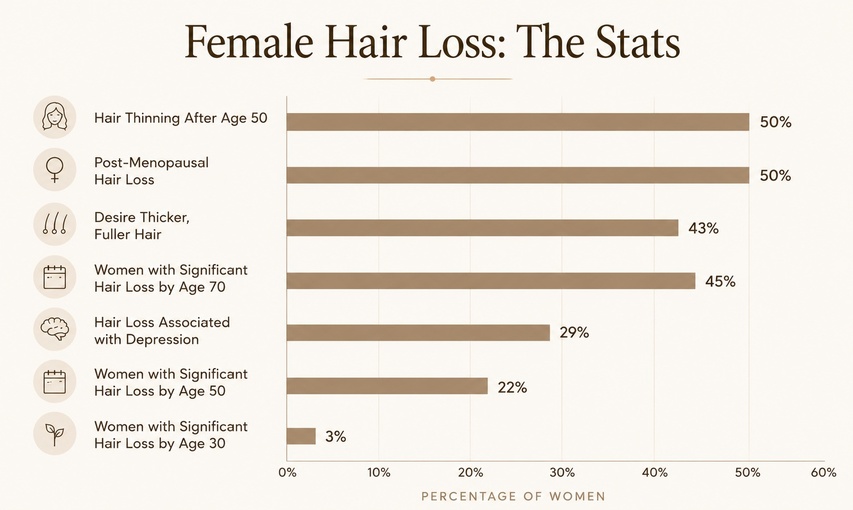
By age 50, roughly 40% of women and 50% of men will experience noticeable hair loss. Research shows the diameter of individual hair shafts in women peaks around age 40 and gradually declines after that; in men, shaft diameter has been shown to start declining as early as 25.
What Causes Hair Loss in Women After 60?
Hormonal changes are the primary driver: as estrogen and progesterone decline after menopause, the relative effect of androgens (including DHT) on hair follicles increases, accelerating female pattern hair loss. Slower cell turnover, reduced scalp circulation, and cumulative UV/styling damage compound the effect over decades.
What's the Best Medicated Treatment for Hair Loss After 60?
Best for: women who want an FDA-approved, clinically established option.
Minoxidil is the most extensively studied topical treatment for hair loss and is FDA-approved for use in both men and women. It works by increasing blood flow, oxygen, and nutrient delivery to the scalp, which helps keep follicles in the active growth (anagen) phase longer and can increase the number of active follicles over time.
Minoxidil vs. Drug-Free Serum: Which Is Right for You?
| Minoxidil 2% | Drug-Free DHT-Blocking Serum | |
|---|---|---|
| Type | FDA-approved OTC drug | Cosmetic botanical/peptide formula |
| Mechanism | Increases scalp blood flow; extends growth phase | Blocks DHT topically; supports scalp environment |
| Best for | Genetic/age-related thinning, women wanting the most-studied option | Women who prefer a minoxidil-free routine or have sensitivity to minoxidil |
| Onset | Typically 4–6 months of consistent use | Varies; often used alongside a supplement for a fuller routine |
| Regulatory status | Regulated drug, not evaluated for cosmetic-only claims | Cosmetic; not intended to diagnose, treat, cure, or prevent disease |
Bottom line: if you want the most clinically established option, start with minoxidil. If you'd rather avoid a topical drug, a DHT-blocking serum plus a supportive supplement and shampoo is the drug-free path.
What Are the Best Drug-Free Treatment Serums for Women After 60?
Best for: a minoxidil-free routine.
Dihydrotestosterone (DHT) contributes to hair loss in both men and women. The MDhair Restore Serum contains 20 dermatologist-formulated botanical complexes and plant proteins, including biomimetic copper peptides that stimulate scalp capillaries to direct oxygen and micronutrients to the follicles, plus topical DHT blockers such as saw palmetto, berry extract, rosemary leaf oil, and Panax ginseng root. Hydrolyzed rice and oat proteins help hair and scalp bind moisture, and Fo-ti root extract supports scalp health.
The MDhair Regrowth Serum also uses active DHT-blocking plant extracts, along with ingredients that help calm scalp inflammation, irritation, and itchiness, support blood circulation, and provide antioxidant protection against environmental stressors.
What Are the Most Effective Hair Supplements for Women After 60?
Best for: replenishing nutrients depleted with age, alongside a topical routine.
Hair supplements and collagen peptides help replenish vitamins, minerals, and amino acids that decline with age. The MDhair Regrowth Supplements are formulated for women with genetic, age-related, and menopausal hair loss — vegan, sugar-free, and taken as one daily capsule. They combine DHT-blocking saw palmetto, nettle leaf extract, and Reishi and Maitake mushroom extracts with biotin and vitamins B6, B9, and D, folic acid, zinc, and calcium to support healthy hair growth.
Supplements vs. Topical Serum: Do You Need Both?
| Topical Serum | Oral Supplement | |
|---|---|---|
| Approach | Direct scalp/follicle action | Internal nutrient support |
| Best for | Targeting the scalp environment and DHT directly at the source | Replenishing biotin, zinc, and B-vitamins depleted with age |
| Typical use | Daily scalp application | Daily capsule |
Bottom line: the two work on different pathways — most women see the fullest results combining a topical serum with a supplement rather than choosing one over the other.
What's the Best Shampoo and Conditioner for Aging Hair?
Sulfate-free shampoos containing salicylic acid, lactic acid, tea tree oil, and green tea can reduce oxidative stress and scalp inflammation. The MDhair Regrowth Shampoo uses saw palmetto and pumpkin seed oil to help follicles transition into the active growth phase, along with green tea and sage to calm irritation and balance the scalp microbiome. It's vegan, silicone-free, sulfate-free, paraben-free, fragrance-free, and color-safe.
Hair becomes drier and less regular in curvature with age, making it frizzier. The MDhair Restore Conditioner uses keratin, silk peptides, argan oil, avocado oil, and black cumin seed oil to protect against dryness and frizz without weighing hair down.
What's the Best Collagen for Hair Loss After 60?
Collagen peptides support collagen production for hair, skin, nails, and joints. Marine collagen contains more Type I collagen — considered more beneficial for hair, skin, and nails than bovine sources. MDhair Marine Collagen, sourced from Alaskan wild deep-sea fish, is combined with hyaluronic acid for hydration and vitamin C to support new collagen production.
Ingredient Spotlight: What's Actually in These Formulas?
- Saw palmetto — plant-derived DHT blocker that may help reduce the hormonal driver behind genetic thinning.
- Copper peptides — signal peptides that support the scalp environment and follicle health.
- Biotin — a B-vitamin involved in keratin production, supporting hair, skin, and nail structure.
- Marine collagen — hydrolyzed peptides that support hair, skin, and nail quality from the inside out.
- Fo-ti (Polygonum multiflorum) — a traditional botanical used to support scalp health and associated with reduced hair graying in traditional use.
Does MDhair Work? What the Clinical Data Shows
In a company-sponsored 24-week study of MDhair's regimen, participants self-reported:
| Result | Reported by |
|---|---|
| Thicker hair | 88.9% of participants |
| Decreased shedding | 88.9% of participants |
| Decreased brittleness | 92.6% of participants |
| Adverse events | None reported |
Individual results vary. This is self-reported outcome data from an MDhair-sponsored study, not a guarantee of results.
Is There a Way to Slow Hair Graying?
Ho Shou Wu (Fo-ti), a traditional Chinese herbal remedy, has long been used to help reduce hair graying — the name translates roughly to "Mr. Ho's hair is black," from folklore about a man whose gray hair reportedly darkened after using the herb.
Common Mistakes That Cause Hair Thinning After 60
Using the wrong shampoo
Sulfates (SLS) create foam but can irritate the scalp; fragrance can trigger inflammation. Switch to a sulfate-free, fragrance-free regrowth shampoo.
Overwashing
Washing more than 2–3 times a week can stimulate excess oil production and flatten hair — use a volumizing shampoo and conditioner instead.
Overusing heat styling
Use a heat protectant and the lowest effective heat setting.
Drying with a regular bath towel
Coarse towel fibers damage hair — use an old cotton t-shirt or microfiber towel instead.
Not eating enough protein and micronutrients
A diet rich in vegetables and protein supports regrowth.
Skipping hair supplements
Relying on sugary hair gummies instead of formulated capsules provides fewer active ingredients.
Skipping collagen peptides
Especially marine collagen with hyaluronic acid.
Skipping a scalp treatment serum
Scalp care supports the transition from resting (telogen) to active growth (anagen) phase.
Recommended MDhair Routine for Women After 60
- Best medicated topical scalp treatment: Minoxidil 2%
- Best plant-based, minoxidil-free scalp serum: Restore Serum
- Best shampoo for thinning, aging hair: Regrowth Shampoo
- Best oral supplement: Regrowth Supplements
- Best collagen for hair, skin, and nails: Marine Collagen
- Best for dry, damaged strands: Peptide Bond Repair Oil
Not sure where to start? Take the free hair assessment for a personalized routine.
FAQ
Is minoxidil safe for women over 60?
Yes — minoxidil 2% is FDA-approved for mild-to-moderate androgenetic hair loss in women and is considered one of the safest medical-grade options available. As with any treatment, women with underlying medical conditions or who are on other medications should check with their doctor first.
What's the difference between minoxidil and a DHT-blocking serum?
Minoxidil is an FDA-approved drug that increases scalp blood flow to extend the hair's growth phase. A DHT-blocking serum is a cosmetic product that uses plant-based ingredients like saw palmetto to reduce DHT's effect on follicles topically. They can be used separately or combined, depending on whether you want a drug-free routine.
Can hair loss after 60 be reversed?
Full reversal isn't guaranteed for everyone, but many women see measurably thicker, less brittle hair with consistent use of the right combination of treatments — a scalp serum or minoxidil, a supportive shampoo, and an oral supplement. Results vary by individual.
Do I need both a supplement and a topical serum?
They target different things — the serum acts directly on the scalp and follicles, while a supplement replenishes nutrients like biotin, zinc, and B-vitamins that decline with age. Most women see the best results using both together rather than just one.
Is collagen worth taking for hair loss after 60?
Collagen peptides, especially marine collagen with hyaluronic acid, support the structural proteins involved in hair, skin, and nail health. It's typically used as a complement to — not a replacement for — a DHT-focused serum or supplement.
Why is my hair drier and more brittle after 60, not just thinner?
Declining estrogen and progesterone after 60 reduce the scalp's natural sebum production, the oil that keeps hair looking smooth. That's why a routine for older hair usually needs a conditioning/repair step in addition to a regrowth serum.
How long does it take to see results from a hair loss routine after 60?
Most topical and oral treatments, including minoxidil, take around 4–6 months of consistent use before visible changes appear, since hair growth cycles are slow. In MDhair's 24-week clinical study, the majority of participants reported thicker hair and less shedding by that point.
What causes sudden extra shedding in older women, separate from normal aging?
Sudden or acute shedding (telogen effluvium) can be triggered by illness, major stress, surgery, or medication changes, and typically starts 6–8 weeks after the trigger. This is different from the gradual thinning of age-related hair loss and is usually temporary.
References
- A Comment on the Science of Hair Aging
- Sinclair, R. D. (2007). Aging hair. Journal of Cosmetic Dermatology, 6(2), 76-82.
- Trüeb, R. M. (2005). Molecular mechanisms of hair aging. Annals of the New York Academy of Sciences, 1057(1), 1-8.
More Info
Find the most effective hair growth products for you by taking the free hair assessment.
Enjoyed this article? Add MDhair as a preferred source on Google.