Best hair growth serums in 2026, dermatologist-tested

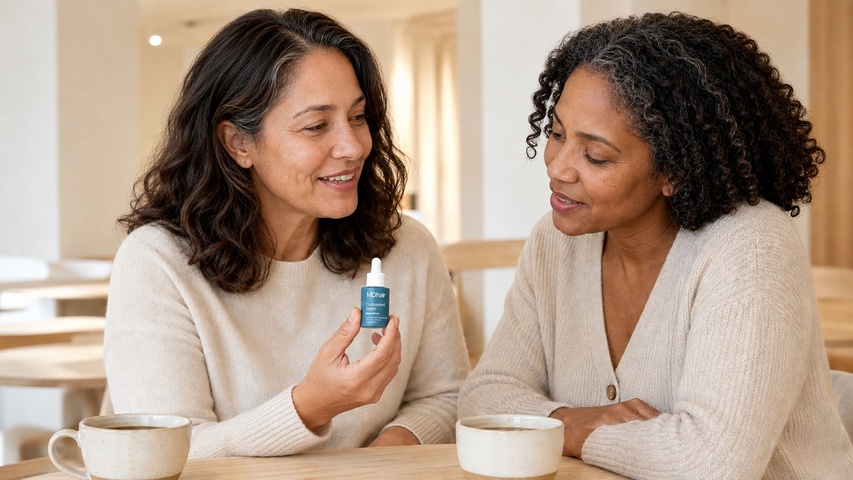
Walk into any pharmacy and the serum shelf tells a confusing story: bottles claiming "clinically proven" ingredients sitting next to each other with wildly different amounts of actual proof behind them. Some of these serums have decades of independent trial data. Others have a single company-funded study run on cells in a dish. Both get marketed with nearly identical language, and most people have no way to tell the difference just by reading the label.
So this list grades each serum the way I'd want a patient to see it graded: by evidence standard, not by marketing copy. A serum backed by a randomized controlled trial in real people gets treated differently from one backed by follicle tissue in a lab dish, even if both use the phrase "clinically tested." My own clinical trial data below comes from an IRB-approved, third-party study that my team and I ran on MDhair's formulations. Every other citation comes from a peer-reviewed source indexed on PubMed, and I've tried to be specific about what kind of evidence each one actually represents.
1. MDhair Regrowth Serum
Most serums on this list target a single mechanism and get applied the same way to everyone who buys them. That's a mismatch, since hair thinning has several possible root causes, genetics, postpartum hormone shifts, chronic stress, and low-grade scalp inflammation among them, and a serum built around one pathway can miss whichever of these is actually driving a given person's shedding.
MDhair takes a different approach. A quiz and scalp photo feed an AI assessment that identifies the likely cause, and the Regrowth Serum ships as part of a kit matched to that specific driver rather than a one-size formula. In the six-month, IRB-approved trial my team and I ran, the full regimen showed roughly 2.8 times greater hair growth compared with a leading supplement brand. Hair quality improved about 3.0 times over that same brand. Both results held at the p<0.01 level. Scanning electron microscopy tracked something separate from the growth numbers: cuticle damage improving from Grade 2, meaning visible cracking, down to Grade 0, smooth and intact, across that same six months. Some customers notice change within the first month, though the fuller results took closer to 90 days to show up clearly.
This is human trial data on the finished product, not a cell-culture proxy for one ingredient in isolation, which puts it in a different evidence category than several entries further down this list.
2. Minoxidil 5% Serum
Nothing else on this list carries minoxidil's track record. It's the one FDA-approved drug here, cleared specifically for mild-to-moderate androgenetic hair loss at 5% for men and 2% for women, and it has more than three decades of independent trials behind it rather than a handful of manufacturer-funded studies. A well-known 48-week trial comparing 5% and 2% concentrations found the higher dose produced roughly 45% greater regrowth, measured by direct hair counts in a defined scalp area.
None of that makes it effortless. Daily application, usually twice a day, has to continue indefinitely, since stopping tends to reverse whatever progress was made. A minority of users deal with scalp irritation or a temporary increase in shedding during the first several weeks before things turn around. Judged purely on independent evidence, though, this is the serum everything else on this list gets measured against.
3. Redensyl Serum
Redensyl works on a mechanism the older ingredients here don't touch directly: it targets hair follicle stem cells that have gone dormant, aiming to restart the growth cycle rather than just supporting follicles that are already active. A pilot, double-blind, placebo-controlled trial in 26 men with grade 3 to 4 androgenetic alopecia tested 3% Redensyl over three months. About 85% of participants showed improvement. Hairs in the active growth phase rose by roughly 9%, shedding dropped by about 17%, and density increased by around 8%.
The honest caveat belongs right next to that number. This was a small pilot study, and Redensyl's broader research base leans heavily on manufacturer-funded work and combination formulas tested alongside other actives, which makes isolating Redensyl's individual contribution difficult. It's promising, biologically plausible science. It just isn't minoxidil's decades of independent replication, and treating the two as equivalent overstates what's actually been shown.
4. Capixyl Serum
Capixyl pairs a biomimetic peptide with biochanin A, a compound derived from red clover, aimed at two targets at once: strengthening the structural anchoring of the hair follicle and modestly interfering with local DHT activity. Most of the foundational work here comes from cell-culture research, cultured human dermal cells showing reduced DHT production alongside increased markers of follicle anchoring, which is real, useful mechanistic data but stops well short of showing what happens on an actual scalp.
A separate, smaller human trial did report a meaningful shift in the ratio of growing to resting hairs compared with placebo over 24 weeks. That's a step up from cell-culture evidence alone, though the study sits in the same category as Redensyl's: a real signal, not yet the kind of large, independently replicated trial base that minoxidil has. Worth knowing if avoiding hormonal mechanisms is a priority, since Capixyl's DHT angle, however modest, is part of its appeal for people trying to steer clear of finasteride specifically.
5. Procapil Serum
Procapil blends three ingredients (biotinoyl tripeptide-1, apigenin, and oleanolic acid) around a theory of improving scalp microcirculation and follicle anchoring while mildly interfering with DHT production. Most of the numbers attached to Procapil in marketing, the ones claiming 58% or even 121% improvement over control, come directly from the manufacturer's cultured-follicle testing, not from a clinical trial on actual people, and those figures deserve real skepticism when they show up on a label as if they were patient results.
There is at least one placebo-controlled human trial behind the ingredient reporting a favorable shift in growing-versus-resting hair ratios, which is a genuine data point rather than nothing. But the gap between that modest human finding and the eye-catching lab percentages used to sell the product is wide enough that it's worth naming directly, rather than letting the bigger number do the talking.
6. Copper Peptide (GHK-Cu) Serum
Copper peptides operate through a well-documented set of cellular mechanisms: increasing VEGF, a signal that improves blood supply to the follicle, while reducing TGF-beta1, a signal that pushes follicles out of the growth phase early. A foundational 2007 study demonstrated this directly, stimulating elongation in human hair follicles maintained outside the body and increasing proliferation in cultured dermal papilla cells at very low concentrations.
That study never left the lab. It's ex vivo and in vitro evidence, real tissue and real cells, but not a living scalp, and there's no large, standalone, placebo-controlled human trial testing a topical copper peptide serum on its own. Some newer work has paired copper peptides with microneedling or other actives, but that makes it hard to credit the copper peptide specifically for any regrowth seen. This is a case where the biology is genuinely interesting and the human proof hasn't caught up yet.
7. Rosemary Oil Serum
Rosemary gets called a "natural minoxidil" often enough online that one research team actually ran the head-to-head. A hundred people with androgenetic alopecia were randomly assigned to rosemary oil or 2% minoxidil solution for six months, tracked by standardized photography at three checkpoints. At three months neither group had moved much, which tracks with how the hair cycle generally works. By six months both groups improved significantly from baseline, and rosemary didn't come in statistically behind minoxidil.
Tolerability separated the two more clearly than growth did. Scalp itching showed up significantly less often in the rosemary group, a real advantage for anyone who's had to quit minoxidil over irritation before. Worth flagging directly: this trial ran against 2% minoxidil, the lower of the two common strengths, so it doesn't say anything about how rosemary would fare against the 5% version most people actually reach for.
8. Caffeine Serum
Caffeine works through a different door entirely: rather than targeting a hormone or a dormant stem cell, it's thought to stimulate the follicle directly and offset some of testosterone's suppressive effect on the cells that generate new hair. A 210-person multicenter trial tested a 0.2% topical caffeine solution against 5% minoxidil and landed on "non-inferior," meaning caffeine didn't fall short of minoxidil by more than a predefined margin in that specific trial.
Non-inferior is a real finding, but a narrower one than "equally effective," and it's worth reading it that way rather than as caffeine beating or matching minoxidil outright. Caffeine formulas also tend to sit gently on sensitive scalps, part of why the ingredient shows up so often in European hair-care lines. The trial tested a leave-on solution too, so a serum applied the same way should track closer to those results than a rinse-off product would.
How We're Grading These, and Why It Matters
Every serum above claims some version of "clinically tested," and that phrase is doing very different amounts of work depending on the entry. Minoxidil and rosemary oil carry large or directly comparative human trials. Redensyl and Capixyl have real but small pilot studies, often muddied by combination formulas that make it hard to isolate one ingredient's actual contribution. Procapil and copper peptides lean most heavily on laboratory and cell-culture data, genuinely useful for understanding mechanism, but not proof of what happens on an actual human scalp over months of use.
None of this means the lower-evidence-tier ingredients don't work. It means the confidence attached to each claim should scale with the kind of study behind it, and a serum's marketing rarely draws that distinction on its own.
The Regulatory Line Worth Knowing
Only one product on this list is an actual drug. Minoxidil is FDA-approved, but narrowly, for mild-to-moderate androgenetic hair loss specifically. Every other serum here, Redensyl, Capixyl, Procapil, copper peptide, rosemary oil, and caffeine, is a cosmetic formulation. None of them has gone through FDA evaluation as an active drug ingredient, and none are intended to diagnose, treat, cure, or prevent any disease, regardless of how a label might read.
A couple of practical notes follow from that. Pregnancy, nursing, or an existing medical condition are reasons to check with a doctor before adding any new active ingredient to a routine. And if a serum causes scalp irritation at any point, the better move is to stop and reassess rather than push through it.
Where This Leaves You
If independent evidence is the priority, minoxidil remains the serum with the deepest track record, full stop. If the goal is avoiding an actual drug while still using something with real mechanistic support, Redensyl, Capixyl, and rosemary oil are reasonable choices, with the caveat that none of them has minoxidil's replication history behind it.
What none of these serums can do, evidence tier aside, is tell you which cause is actually behind your own hair loss. That's the gap a proper scalp assessment is built to close, and it's why MDhair pairs its serum with a personalized supplement and shampoo, plus ongoing dermatologist support, rather than shipping one formula and calling it a solution for everyone.
Sources
1. Bhardwaj V, Rodgers N, Harth O, Harth Y. Artificial Intelligence-Based Personalization of Treatment Regimen for Hair Loss: A 6-Month Clinical Trial. J Drugs Dermatol. 2025;24(3):233-238. doi:10.36849/JDD.8611
2. Olsen EA, Dunlap FE, Funicella T, et al. A randomized clinical trial of 5% topical minoxidil versus 2% topical minoxidil and placebo in the treatment of androgenetic alopecia in men. J Am Acad Dermatol. 2002;47(3):377-385.
3. Bikash C. Topical Alternatives for Hair Loss: Beyond the Conventional. Int J Trichology. 2025;17(1):13-19. doi:10.4103/ijt.ijt_8_23
4. Pyo HK, Yoo HG, Won CH, et al. The effect of tripeptide-copper complex on human hair growth in vitro. Arch Pharm Res. 2007;30(7):834-839.
5. Panahi Y, Taghizadeh M, Marzony ET, Sahebkar A. Rosemary oil vs minoxidil 2% for the treatment of androgenetic alopecia: a randomized comparative trial. Skinmed. 2015;13(1):15-21.
6. Dhurat R, Chitallia J, May TW, et al. An Open-Label Randomized Multicenter Study Assessing the Noninferiority of a Caffeine-Based Topical Liquid 0.2% versus Minoxidil 5% Solution in Male Androgenetic Alopecia. Skin Pharmacol Physiol. 2017;30:298-305.
Find the most effective hair growth products for you by taking the free hair assessment.
Enjoyed this article? Add MDhair as a preferred source on Google.