Build your hair growth stack: the science behind combining topical + oral treatments

Key Points
- The "supplement stacking" trend has surged over 672% year-over-year, reflecting a cultural shift toward layered, multi-angle health optimization — and hair care is no exception.
- Combining topical treatments (minoxidil, DHT-blocking serums) with oral supplements (vitamins, adaptogens, DHT blockers) targets hair loss from both the inside and outside, producing significantly better results than any single product alone.
- A 6-month clinical trial of the MDhair Customized Kit showed a 37% reduction in shedding, improved hair density, and stronger hair shafts — with no adverse effects.
If you've spent any time on TikTok or Instagram lately, you've probably come across the concept of "stacking" — layering multiple wellness products and habits to maximize results. According to the Spate 2026 Global Culture Shifts Report, which analyzes over 900 billion search signals across Google, TikTok, and Instagram, the trend for "supplement stacks" has exploded by 672% year-over-year. The broader "Optimization Mindset" driving this shift now commands an average monthly popularity of 86.6 million, up 49.3% from last year.
This isn't just about fitness buffs adding creatine to their protein shakes. The stacking mindset has reached skincare, wellness, and — most relevant to us — hair care. More and more people are realizing that a single product isn't enough to fight hair loss. The real breakthroughs happen when you combine treatments that work through different biological pathways, creating what we call a hair growth stack.
In this post, we'll break down the science behind combining topical and oral treatments, explain why this layered approach works, and show you how to build your own evidence-based hair growth stack.
Why a single treatment often isn't enough
Hair loss is rarely caused by one thing. For most people, it's a combination of genetic predisposition (DHT sensitivity), nutritional deficiencies, hormonal shifts, stress, and scalp inflammation — all working together to push hair follicles from the growth phase into the resting phase.
A topical treatment like minoxidil can stimulate blood flow to the scalp and extend the growth phase, but it does nothing to address a vitamin D deficiency or elevated cortisol levels. Likewise, taking biotin supplements alone won't block DHT from shrinking your follicles if you have androgenetic alopecia.
This is exactly why the stacking approach makes sense. When you layer treatments that target different root causes simultaneously, the combined effect is far greater than the sum of its parts.
The two pillars of an effective hair growth stack
Pillar 1: Topical treatments — working from the outside in
Topical treatments deliver active ingredients directly to the scalp and hair follicles, where they're needed most. The key categories include:
Minoxidil
FDA-approved and clinically proven, minoxidil is the gold standard for topical hair loss treatment. It works by widening blood vessels in the scalp, increasing nutrient delivery to follicles, and extending the anagen (growth) phase. Women should use a 2% concentration, applied twice daily for 4–6 months for optimal results.
DHT-blocking scalp serums
For those who prefer a plant-based alternative or want to complement minoxidil, DHT-blocking serums use botanical extracts like saw palmetto, caffeine, green tea, and rosemary oil to counteract the hormone that causes follicle miniaturization. The best formulations also include peptide complexes that stimulate follicle activity and prolong the growth cycle.
Probiotic scalp shampoos
Your scalp has its own microbiome, and when it's out of balance, inflammation and irritation can push follicles into the resting phase prematurely. Probiotic shampoos with Lactobacillus ferment and anti-inflammatory botanicals like niacinamide and green tea create a calm, nutrient-rich environment where hair can thrive.
Pillar 2: Oral supplements — building from the inside out
While topical treatments address the scalp environment directly, oral supplements work systemically to ensure your body has everything it needs to produce strong, healthy hair. The critical oral components include:
Vitamins and minerals
Biotin, vitamins D, E, C, B-complex, zinc, selenium, and iron are all essential building blocks for keratin production and follicle health. Deficiencies in any of these can trigger or worsen hair shedding. The Spate report found that "skin boosters" — products that enhance your body's own regenerative capacity — have grown 63.8% year-over-year to a popularity index of 8.9 million, reflecting consumer demand for inside-out health optimization.
Natural DHT blockers
Oral DHT blockers like saw palmetto berry extract and pygeum bark prevent the conversion of testosterone into DHT, the hormone responsible for follicle shrinkage in androgenetic alopecia. Taking these internally provides systemic DHT protection that complements topical DHT-blocking serums applied directly to the scalp.
Adaptogens for stress management
Here's where the latest cultural trends intersect powerfully with hair science. The Spate report identifies "Nervous System Maxxing" as the top cultural shift of 2026, with a combined year-over-year growth of 165.4% and an average monthly popularity of 75.1 million. The data shows that searches for "nervous system regulation" have skyrocketed 982.7%, "chronic stress" is up 71%, and magnesium supplementation has grown 65.3%.
Why does this matter for your hair? Chronic stress elevates cortisol, which disrupts the hair growth cycle by prematurely pushing follicles into the telogen (resting) phase, leading to diffuse shedding known as telogen effluvium. Adaptogenic herbs like ashwagandha, reishi mushroom, and maitake mushroom help regulate cortisol levels, support immune function, and combat the oxidative stress that damages follicles. Including adaptogens in your hair growth stack addresses one of the most overlooked — yet increasingly common — drivers of hair loss.
Amino acids and collagen peptides
Collagen peptides and amino acids provide the structural building blocks for hair strands and the scalp matrix. They're especially important during the recovery phase after a shedding episode, helping new hair grow back thicker and stronger.
The science of synergy: why stacking works better
The concept isn't just trendy — it's backed by research. When you combine treatments that work through different mechanisms, you get synergistic effects:
- Topical minoxidil + oral DHT blockers: Minoxidil stimulates blood flow and extends the growth phase, while oral DHT blockers prevent follicle miniaturization. Together, they address both the supply side (more nutrients reaching the follicle) and the threat side (less hormonal damage).
- Scalp probiotics + oral adaptogens: A healthy scalp microbiome reduces local inflammation, while adaptogens lower systemic cortisol. This dual approach ensures follicles aren't being attacked from either direction — neither from an inflamed scalp environment nor from stress hormones circulating through the bloodstream.
- Topical peptides + oral vitamins: Peptides applied to the scalp signal follicles to stay in the growth phase longer, while vitamins and minerals ensure those follicles have the raw materials to actually produce strong, healthy hair.
This multi-angle strategy is exactly what the Spate report's "Optimization Mindset" trend describes: consumers are no longer looking for a magic bullet. They're building layered routines to maximize outcomes at every step, from "playful gummies to powders that can be mixed into food and drinks to upgrade everyday consumption." The same logic applies to hair care.
The MDhair Customized Kit: a clinically proven hair growth stack
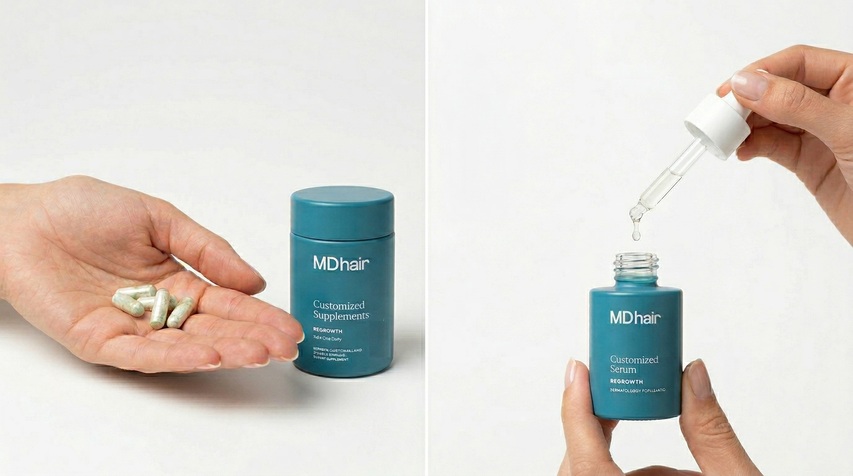
Building your own stack from scratch can be overwhelming — figuring out which ingredients work together, what concentrations are effective, and how to sequence your routine. That's exactly why the MDhair Customized Kit exists. It brings all three pillars together in a personalized system:
Hair Regrowth Supplements — Biotin, vitamins D, E, C, B-complex, zinc, selenium, saw palmetto, pygeum bark (DHT blockers), and adaptogens including ashwagandha, reishi, and maitake mushrooms. These address nutritional deficiencies, block DHT systemically, and regulate cortisol — all in one daily dose.
Probiotic Scalp Shampoo — Lactobacillus ferment to balance the scalp microbiome, plus green tea extract, niacinamide, and saw palmetto to soothe inflammation and create an optimal environment for growth.
Topical Growth Serum — Caffeine, green tea, biotin, peptide complexes, and botanical DHT blockers to stimulate follicles directly and prolong the anagen phase.
Clinically proven results
A 6-month clinical trial published in the Journal of Drugs in Dermatology in March 2025 tested the MDhair multi-therapy regimen in 38 women with self-perceived hair thinning. The results speak for themselves:
- 37% reduction in hair shedding at 12 weeks (32% at 24 weeks)
- 69% decrease in scalp transepidermal water loss, indicating a healthier scalp barrier
- Over 85% of participants reported better scalp health and reduced brittleness
- Significant improvements in hair density, thickness, and overall volume
- No adverse effects — participants saw visible regrowth, stronger hair shafts, and improved scalp comfort
These results confirm that a properly designed hair growth stack — combining topical and oral treatments that target different biological pathways — delivers measurable, clinically significant improvements.
How to build your routine
Getting started with a hair growth stack doesn't have to be complicated. Here's a simple daily framework:
Morning:
- Wash with a probiotic scalp shampoo 3–4 times per week.
- Apply your topical growth serum or minoxidil to a clean, dry scalp.
- Take your hair regrowth supplements with breakfast.
Evening:
- Apply a second dose of topical serum or minoxidil before bed.
- Practice a brief stress-reduction technique — even two minutes of deep breathing or a scalp massage can help lower cortisol and improve blood flow.
Give it time: Hair follicles operate on a cycle measured in months, not days. Most people begin to notice reduced shedding within 8–12 weeks, with visible improvements in density and thickness by 4–6 months. Consistency is everything.
The bottom line
The era of relying on a single product to fight hair loss is over. The data is clear: consumers are embracing layered, multi-angle approaches to wellness — and the science supports it. By combining topical treatments that optimize your scalp environment with oral supplements that nourish follicles from within and manage stress hormones, you create a comprehensive hair growth stack that addresses hair loss at every level.
Ready to build your personalized hair growth stack? Take the free hair assessment at mdhair.co and get a customized treatment plan designed by dermatologists — tailored to your specific hair type, concerns, and goals.
References
- Spate. (2026, March). 2026 Global Culture Shifts Report: Key Themes and Trends.
- Katoulis AC, et al. Integrative and Mechanistic Approach to the Hair Growth Cycle. J Clin Med. 2023;12(3):893.
- Choi S, et al. Corticosterone Inhibits GAS6 to Govern Hair Follicle Stem-Cell Quiescence. Nature. 2021;592:428–432.
- Asghar F, et al. Telogen Effluvium: A Review of the Literature. Cureus. 2020;12(5):e8320.
- Chandrasekhar K, et al. Safety and Efficacy of Ashwagandha Root Extract in Reducing Stress. Indian J Psychol Med. 2012;34(3):255–262.
- Thom E. Stress and the Hair Growth Cycle: Cortisol-Induced Hair Growth Disruption. J Drugs Dermatol. 2016;15(8):1001–1004.
- Bhardwaj V, et al. AI-Based Personalization of Treatment Regimen for Hair Loss: A 6-Month Trial. J Drugs Dermatol. 2025;24(3):233–238.
- Rodrigues A. "Everybody Has a 'Stack' Now." GQ. 2023, Apr 24.
- Minoxidil and its use in hair disorders: a review. Drug Des Devel Ther. 2019;13:2777–2786.
- Rossi A, et al. Comparative Effectiveness of Finasteride vs Serenoa Repens in Male Androgenetic Alopecia. Int J Immunopathol Pharmacol. 2012;25(4):1167–1173.
Find the most effective hair growth products for you by taking the free hair assessment.
Enjoyed this article? Add MDhair as a preferred source on Google.