Why doesn't minoxidil work for everyone?

Quick Answer: Why doesn't minoxidil work for everyone?
- Minoxidil is a prodrug. It does nothing to your hair follicles until an enzyme in your scalp, sulfotransferase SULT1A1, converts it into its active form, minoxidil sulfate.
- SULT1A1 activity varies enormously between people. Studies of plucked hair follicles show that responders consistently have higher follicular sulfotransferase activity than non-responders [1][2].
- A simple colorimetric assay can predict response before you start. The test measures minoxidil-to-minoxidil-sulfate conversion in plucked follicles, using an optical density reading at 405 nm, with roughly OD 0.4 used as the responder/non-responder cutoff [1][3].
- Resistance is not always permanent. In a small study, five days of 0.1% tretinoin converted 43% of predicted non-responders into predicted responders by upregulating follicular sulfotransferase [4].
- Everyday factors matter too. Low-dose daily aspirin has been shown to reduce follicular sulfotransferase activity and blunt topical minoxidil efficacy [5].
- If minoxidil isn't working, the answer is a different mechanism — DHT-blocking actives, copper peptides, microneedling, low-level laser therapy, or oral minoxidil — not simply more of the same.
What is androgenetic alopecia, and why is minoxidil the default treatment?
This section covers the biology of pattern hair loss and where minoxidil fits into it.
Androgenetic alopecia (AGA) — male and female pattern hair loss — is the most common cause of hair thinning worldwide, affecting an estimated 50% of men by age 50 and a substantial proportion of women, particularly after menopause. It is a progressive, genetically driven condition in which sensitive follicles respond to dihydrotestosterone (DHT) by shortening their growth (anagen) phase with each cycle.
The result is follicular miniaturization: terminal hairs are gradually replaced by shorter, finer, less pigmented vellus-like hairs. The follicle doesn't disappear overnight — it shrinks, cycle after cycle. That distinction matters clinically, because a miniaturized follicle can often still be rescued, while a fully fibrosed one cannot.
Topical minoxidil became the first FDA-approved treatment for AGA in 1988 and remains the most widely used. It works through several overlapping mechanisms: it opens ATP-sensitive potassium channels, prolongs anagen, shortens telogen, and increases perifollicular blood flow through vasodilation. It does not block DHT, which is why it slows and partially reverses miniaturization rather than addressing the underlying androgenic driver.
The psychological weight of AGA is real and well documented — patients consistently report effects on self-image, social confidence, and mood. Which makes the central problem of this article more than academic: a large share of people who commit to daily minoxidil for a year see disappointingly little regrowth.
What is minoxidil resistance, and how common is it?
Minoxidil resistance means the drug is being applied correctly but isn't producing meaningful regrowth — and the cause is usually biochemical, not behavioral.
Minoxidil resistance describes a patient who uses topical minoxidil consistently and correctly for at least six months — the minimum window for a fair assessment — and shows no meaningful improvement in hair density or caliber. Clinical experience and published cohorts suggest this describes a large minority of users; commonly cited figures put non-response somewhere between 30% and 50% depending on the population, the definition of response, and the duration of use.
The critical insight is this: minoxidil is a prodrug. The molecule you apply to your scalp is essentially inert at the follicle. It must be sulfated — converted to minoxidil sulfate — before it can open potassium channels and act on the dermal papilla. That conversion happens locally, inside the outer root sheath of the hair follicle, and it is carried out by the enzyme sulfotransferase 1A1 (SULT1A1) [2].
If your follicles express too little SULT1A1, you can apply minoxidil twice a day for a decade and generate very little active drug. This is not a compliance problem, an absorption problem, or a "you didn't give it enough time" problem. It's an enzyme problem.
Is it resistance, or is it something else?
Before concluding you're a true non-responder, rule out the mimics:
- Insufficient duration. Visible density change takes 4–6 months; the shedding phase in weeks 2–8 is expected, not failure.
- Under-application. Minoxidil needs to reach the scalp, not sit on hair. A 1 mL dose spread across the affected area, twice daily, is the studied regimen.
- A different diagnosis. Telogen effluvium, thyroid disease, iron deficiency, traction alopecia, and scarring alopecias all masquerade as pattern loss and respond differently.
- Vehicle intolerance. Propylene glycol in older minoxidil solutions causes contact dermatitis in a meaningful minority, leading to inconsistent use.
How does the SULT1A1 enzyme decide whether minoxidil works?
SULT1A1 is the molecular switch that turns minoxidil on — and its activity in your scalp is largely set by genetics.
SULT1A1 is a phase II metabolic enzyme that attaches a sulfonate group to small phenolic compounds. In the hair follicle, its job — as far as minoxidil is concerned — is to convert minoxidil to minoxidil sulfate, the species that actually opens potassium channels in follicular cells.
Two features of SULT1A1 make it clinically decisive:
- Its expression is highly variable between individuals. Copy number variation and single-nucleotide polymorphisms in the SULT1A1 gene produce a wide spread of enzyme activity across the population.
- The relevant activity is local, not systemic. Liver SULT1A1 activity doesn't predict scalp SULT1A1 activity. What matters is the enzyme inside the outer root sheath of your own follicles.
Work by Goren and colleagues established the link directly: patients who responded to topical minoxidil had measurably higher sulfotransferase activity in plucked hair follicles than non-responders [1]. A parallel study in women with female pattern hair loss found the same relationship, with the assay correctly classifying all but two of 21 patients [3]. A 2020 review in Postępy Dermatologii i Alergologii synthesized this literature and concluded that follicular SULT1A1 activity functions as a prognostic marker of minoxidil response in AGA [2].
Can you actually test for it?
Yes — and the test is refreshingly low-tech. A small number of hairs are plucked from the affected area, incubated with minoxidil, and the reaction produces a color change proportional to the amount of minoxidil sulfate formed. The result is read as optical density at 405 nm (OD 405), with a value around 0.4 used as the threshold: below it, the patient is classified as a likely non-responder [1][3].
Two caveats are worth stating plainly. First, the assay predicts probability, not certainty — sensitivity is high but specificity is more modest, meaning some people classified as non-responders will still see some benefit. Second, availability is limited; this remains more common in research and specialty clinics than in routine dermatology practice. Its practical value is in avoiding a wasted year for people who are very unlikely to respond.
What makes minoxidil resistance worse — and what can you actually change?
Some drivers of resistance are fixed by genetics; others are modifiable, and those are where you should focus.
Genetic variability
Polymorphisms and copy-number differences in SULT1A1 set your baseline. You cannot change your genotype — but as the tretinoin data below shows, enzyme activity is not purely fixed, which leaves room to intervene.
Concurrent medications, especially aspirin
This is the most actionable and most overlooked factor. Salicylates are themselves SULT1A1 substrates and inhibitors. In a 2018 study, Goren and colleagues found that patients on low-dose daily aspirin had reduced follicular sulfotransferase activity and correspondingly reduced topical minoxidil efficacy [5]. If you take a daily baby aspirin for cardiovascular prevention and minoxidil isn't working, this is a conversation to have with your physician — never stop a prescribed cardiac aspirin on your own.
Delivery and bioavailability
Minoxidil only works on the follicles it actually reaches. Thick sebum, product buildup, applying to hair rather than scalp, washing shortly after application, or using a vehicle your scalp doesn't tolerate all reduce the amount of drug available for sulfation. Hard water and chlorine exposure contribute to scalp irritation and buildup, which is why scalp preparation is not a trivial detail.
Scalp inflammation
Seborrheic dermatitis and low-grade perifollicular inflammation are common in AGA and independently worsen shedding. An inflamed, scaling scalp is a poor absorptive surface and a hostile environment for regrowth. Treating it is often the fastest visible win.
How can you overcome minoxidil resistance?
If the bottleneck is enzymatic conversion or delivery, there are several evidence-supported ways to widen it.
Can tretinoin make minoxidil work again?
This is the most direct answer to the enzyme problem. In a 2019 study of 20 subjects, 0.1% topical tretinoin applied for five days upregulated follicular sulfotransferase activity, and 43% of participants initially predicted to be non-responders crossed into predicted-responder territory [4]. Tretinoin also thins the stratum corneum, which independently improves minoxidil penetration.
This is a small study and the endpoint was the assay, not photographic regrowth — so treat it as a promising, mechanistically coherent strategy rather than a settled one. Tretinoin is also irritating, and combining it with minoxidil increases both absorption and irritation. It should be done under dermatologist supervision.
Does microneedling help?
Yes — and the evidence here is stronger than for most adjuncts. Microneedling creates controlled micro-injuries that trigger wound-healing signaling, including activation of the Wnt/β-catenin pathway involved in follicular neogenesis, while also dramatically improving transdermal delivery of topicals. A 2024 systematic review and meta-analysis in the Journal of Cosmetic Dermatology found that microneedling combined with topical therapy outperformed topical therapy alone in AGA [6], and randomized trials of microneedling plus 5% minoxidil have reported superior hair counts versus minoxidil alone [7][8].
Practical notes: use a 0.5–1.5 mm device, no more than once weekly, on a clean scalp, and do not apply minoxidil immediately after — wait until the following day to avoid driving irritants into fresh micro-channels.
What about oral minoxidil?
Low-dose oral minoxidil (LDOM) bypasses the scalp delivery problem entirely, and systemic sulfation contributes to producing active drug. Multiple reviews and randomized comparisons published between 2023 and 2025 support LDOM as effective in AGA with an acceptable safety profile in appropriately selected patients [9][10]. It is prescription-only, requires screening for cardiovascular contraindications, and carries real side effects — hypertrichosis, fluid retention, lightheadedness. It is a genuine option for topical non-responders, but a medical one.
Should you just use a higher concentration?
Going from 2% to 5% helps some people, and 5% outperforms 2% in trials. But if your follicles lack the enzyme to activate the drug, doubling the substrate has limited returns and increases irritation. Concentration escalation is a reasonable first step, not a solution to true enzymatic resistance.
What works if minoxidil genuinely isn't your treatment?
Non-response to one mechanism doesn't mean non-response to all of them — and AGA is best treated on multiple fronts anyway.
- DHT-blocking actives. Finasteride and dutasteride reduce DHT and are effective, primarily studied in men; they carry hormonal side-effect considerations and are not appropriate in pregnancy. Topical saw palmetto and pumpkin seed oil have supportive but weaker evidence as botanical 5-alpha-reductase inhibitors.
- Copper peptides. Copper Tripeptide-1 (GHK-Cu) supports perifollicular matrix remodeling, angiogenesis, and anagen prolongation through a pathway entirely independent of sulfotransferase — which is precisely why it's relevant to minoxidil non-responders.
- Low-level laser therapy (LLLT). FDA-cleared caps and combs have randomized evidence for modest density improvement in mild-to-moderate AGA, with an excellent safety profile.
- Platelet-rich plasma (PRP). In-office injections of autologous growth factors show benefit in multiple trials, though protocols are heterogeneous and the treatment is costly and requires maintenance.
- Nutritional correction. Ferritin, vitamin D, zinc, and thyroid status should be checked in anyone with unexplained shedding. Correcting a deficiency won't cure AGA, but leaving one uncorrected caps how well anything else works.
How does MDhair approach minoxidil resistance?
MDhair was built around the premise that hair loss treatment should be matched to the individual — including people whose biology doesn't cooperate with minoxidil.
MDhair's model starts with a free AI scalp assessment: you answer a short questionnaire about your hair history, medications, and goals, upload a scalp photo, and receive a treatment plan built around your specific pattern and contributing factors — with unlimited dermatologist chat support to adjust it over time. Two details from this article feed directly into that intake: your medication list (aspirin being the notable one) and whether you've already tried minoxidil without result.
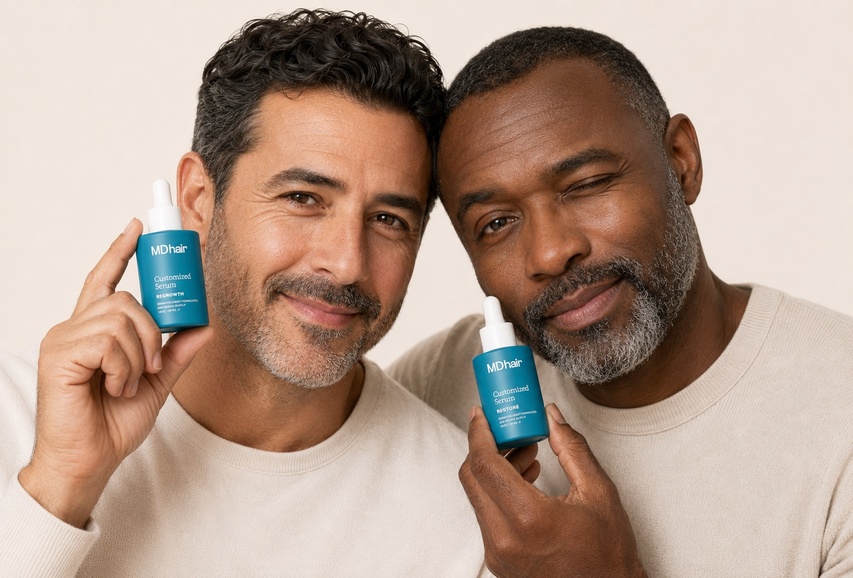
For people who have not responded to minoxidil, the relevant point is mechanistic diversity. The MDhair Customized Regrowth Serum is formulated around actives that do not depend on SULT1A1 conversion:
- Copper Tripeptide-1 (GHK-Cu) — supports collagen and extracellular matrix remodeling around the follicle and perifollicular angiogenesis.
- Saw palmetto (Serenoa serrulata) extract — a botanical with 5-alpha-reductase-inhibiting activity, targeting the DHT arm of AGA that minoxidil never touches.
- Pumpkin seed oil, rosemary extract, and Panax ginseng — botanicals with supportive evidence for scalp circulation and androgen modulation.
- Hydrolyzed silk, rice, and oat proteins, panthenol, and biotin — fiber-level support for caliber and breakage resistance.
Alongside it, the MDhair Customized Shampoo addresses the delivery side of the equation — clearing buildup, calming seborrheic scaling, and preparing the scalp so whatever you apply next actually reaches the follicle. The MDhair Customized Supplements (over 20 vitamins and plant-based complexes) and the MDhair Marine Collagen powder with hyaluronic acid and vitamin C address the nutritional substrate side. For patients who do want to keep a minoxidil component in the plan, MDhair offers Minoxidil 2% and 5% solutions that can be layered into a broader routine rather than relied on alone.
The framing that matters: minoxidil is one mechanism among several. A plan that combines an androgen-pathway active, a peptide-based follicular support, scalp health management, and nutritional correction is not dependent on any single enzyme working in your favor.
Key takeaways
- Minoxidil requires SULT1A1 to work. Low follicular sulfotransferase activity is the leading biochemical explanation for non-response [1][2].
- Give it six months before calling it a failure — and rule out under-application, the wrong diagnosis, and vehicle irritation first.
- Check your medication list. Low-dose daily aspirin measurably reduces minoxidil efficacy [5]; discuss it with your physician rather than stopping it yourself.
- Resistance can sometimes be modified. Short-course 0.1% tretinoin upregulated sulfotransferase and shifted 43% of predicted non-responders in a small study [4]; microneedling improves outcomes when combined with topicals [6][7].
- Non-response to minoxidil is not non-response to treatment. Copper peptides, saw palmetto, LLLT, PRP, and prescription DHT blockers or low-dose oral minoxidil all act through different pathways.
- Personalization is the point. Matching the mechanism to the person — rather than defaulting everyone to the same bottle — is what turns a frustrating year into a productive one.
Frequently asked questions about minoxidil resistance
How long should I use minoxidil before deciding it isn't working?
At least six months of consistent, correctly applied use. Regrowth in AGA follows the hair cycle, and density changes are rarely visible before month four. The initial shedding that many people experience in weeks 2–8 is a sign the drug is pushing follicles into a new anagen phase — not a sign of failure.
Can I get my SULT1A1 activity tested?
The colorimetric plucked-follicle assay exists and is described in the peer-reviewed literature [1][3], but it is not yet a routine clinical test in most dermatology practices. Availability is limited to research settings and some specialty clinics. In practical terms, most people effectively "test" by trialing minoxidil for six months.
Does taking a daily aspirin really block minoxidil?
Published data show that low-dose daily aspirin reduces follicular sulfotransferase activity and blunts topical minoxidil efficacy [5]. If you take aspirin for cardiovascular protection, do not stop it — the cardiac benefit outweighs the hair consideration. Instead, discuss it with your physician and consider building your hair plan around non-minoxidil mechanisms.
Will switching from 2% to 5% minoxidil fix non-response?
It may help, since 5% outperforms 2% in clinical trials. But if the limiting factor is enzymatic conversion rather than dose, higher concentration mainly increases irritation. If six months at 5% produces nothing, the problem is likely mechanistic and you should change strategy, not concentration.
Is oral minoxidil a solution for topical non-responders?
Often, yes. Low-dose oral minoxidil bypasses the scalp-delivery bottleneck and has supportive evidence in AGA [9][10]. It requires a prescription, cardiovascular screening, and monitoring, and can cause body hair growth, fluid retention, and lightheadedness. It's a legitimate option — through a physician, not on your own.
Does microneedling actually improve minoxidil results?
Meta-analytic evidence supports microneedling combined with topical therapy over topical therapy alone in AGA [6]. It likely works both by improving drug penetration and by triggering Wnt/β-catenin wound-healing signaling. Use 0.5–1.5 mm depth, no more than weekly, and wait a day before applying topicals to the treated area.
Can women with pattern hair loss be minoxidil non-responders too?
Yes. The sulfotransferase relationship was demonstrated specifically in women with female pattern hair loss, where the assay correctly classified 19 of 21 patients [3]. Women should also be evaluated for ferritin, thyroid function, and hormonal contributors such as PCOS or menopause, which frequently coexist.
Do copper peptides work if minoxidil doesn't?
Copper Tripeptide-1 (GHK-Cu) acts through matrix remodeling, angiogenesis, and anagen support — pathways entirely independent of SULT1A1. That mechanistic independence is exactly why peptide-based serums are a rational choice for minoxidil non-responders, though the clinical evidence base is smaller than minoxidil's.
Will my hair loss come back if I stop treatment?
Yes. AGA is a chronic, progressive condition, and every effective treatment — minoxidil, finasteride, peptides, LLLT — is suppressive rather than curative. Gains achieved over 12 months are typically lost within 3–6 months of stopping. Plan for maintenance from the start.
What single change helps most if minoxidil isn't working?
Get properly assessed. The most common reasons minoxidil "fails" are a wrong diagnosis, an unaddressed deficiency, an inflamed scalp, or a genuine enzymatic non-response — and those four call for four completely different plans. Guessing wastes the one resource you can't get back: follicles.
References
- Goren A, Castano JA, McCoy J, Bermudez F, Lotti T. Novel enzymatic assay predicts minoxidil response in the treatment of androgenetic alopecia. Dermatologic Therapy. 2014;27(3):171–173.
- Ramos PM, Sinclair RD, Kasprzak M, Miot HA. Sulfotransferase SULT1A1 activity in hair follicle, a prognostic marker of response to the minoxidil treatment in patients with androgenetic alopecia: a review. Postępy Dermatologii i Alergologii (Advances in Dermatology and Allergology). 2020;37(5):634–637.
- Roberts J, Desai N, McCoy J, Goren A. Sulfotransferase activity in plucked hair follicles predicts response to topical minoxidil in the treatment of female androgenetic alopecia. Dermatologic Therapy. 2014;27(4):252–254.
- Sharma A, Goren A, Dhurat R, Agrawal S, Sinclair R, Trüeb RM, Vañó-Galván S, Chen G, Tan Y, Kovacevic M, Situm M, McCoy J. Tretinoin enhances minoxidil response in androgenetic alopecia patients by upregulating follicular sulfotransferase enzymes. Dermatologic Therapy. 2019;32(3):e12915.
- Goren A, Sharma A, Dhurat R, Shapiro J, Sinclair R, Situm M, Kovacevic M, Lotti T, McCoy J. Low-dose daily aspirin reduces topical minoxidil efficacy in androgenetic alopecia patients. Dermatologic Therapy. 2018;31(6):e12741.
- Pei S, et al. Efficacy and safety of combined microneedling therapy for androgenic alopecia: a systematic review and meta-analysis of randomized clinical trials. Journal of Cosmetic Dermatology. 2024;23(6).
- Yu AJ, Luo YJ, Xu XG, et al. Randomized trial of electrodynamic microneedling combined with 5% minoxidil topical solution for treating androgenetic alopecia in Chinese males and molecular mechanistic study of the involvement of the Wnt/β-catenin signaling pathway. Journal of Dermatological Treatment. 2022;33(2):1049–1055.
- Wibowo A, et al. Effectiveness and safety of the combination therapy of micro-needling and minoxidil in androgenetic alopecia of Indonesian men: a randomized controlled trial. Dermatology Reports. 2024.
- Vañó-Galván S, Pirmez R, Sinclair R, et al. Efficacy and safety of low-dose oral minoxidil in the management of androgenetic alopecia. Expert Opinion on Pharmacotherapy. 2024;25(2):139–147.
- Sinclair R, et al. Summation and recommendations for the safe and effective use of topical and oral minoxidil. Journal of the American Academy of Dermatology. 2025.
Related search terms
minoxidil resistance, why doesn't minoxidil work for me, SULT1A1 hair follicle test, minoxidil sulfotransferase assay, minoxidil non-responder, minoxidil not working after 6 months, how to make minoxidil work better, tretinoin and minoxidil combination for hair loss, does aspirin block minoxidil, microneedling with minoxidil results, low dose oral minoxidil for androgenetic alopecia, alternatives to minoxidil for hair loss, copper peptide serum for hair regrowth, female pattern hair loss minoxidil response, best treatment if minoxidil fails
Find the hair regrowth treatment that actually matches your biology by taking the free MDhair scalp assessment.
Recommended Read
- Minoxidil for hair loss: is it the right solution?
- MDhair regrowth serum vs. Minoxidil solution
- Minoxidil pills for hair loss: are they effective?
- Minoxidil or Finasteride for male hair loss?
Find the most effective hair growth products for you by taking the free hair assessment.
Enjoyed this article? Add MDhair as a preferred source on Google.